
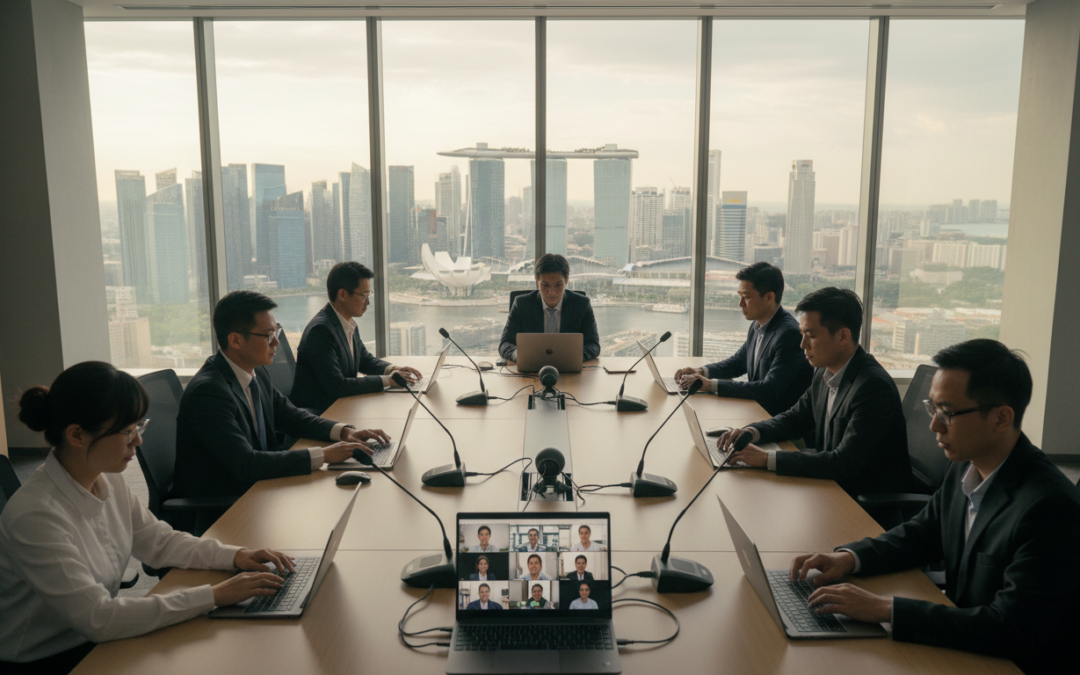
How did organisations keep trust and legal rigour when directors, management and shareholders were scattered across time zones?
The phrase virtual AGM describes the full or partial shift of an annual general meeting to streamed formats with online voting. Past practice in Singapore aimed to meet legal and governance expectations while enabling participation when key stakeholders were not co-located.
Organisations that succeeded linked invitations, registration, documents, streaming and voting into a single workflow. This integration cut errors and improved the stakeholder experience while protecting fiduciary duties.
Common challenges included varied time zones, dispersed shareholders and technical points of failure. The guide that follows focuses on core pillars: secure access, verifiable attendance, orderly Q&A, accurate vote capture and audit‑grade reporting.
Key Takeaways
- Past solutions favoured integrated workflows to reduce confusion and error.
- Secure access and verifiable attendance are central to defensible records.
- Clear live‑day processes guard against technical failure and dispute.
- Accurate vote capture and audit trails support scrutiny and trust.
- Stakeholders such as the board, scrutineer and support teams must be aligned.
Why virtual and hybrid AGMs became standard practice in Singapore
Pandemic-era rules rewired how boards and shareholders meet, making electronic attendance an accepted norm.
From physical halls to online options
In April 2020 authorities moved quickly to let organisations hold meetings by electronic means. This change normalised attendance without travel and cut the carbon footprint.
What dispersed participants mean for design
Many firms now have directors and shareholders joining from overseas. That reality shaped meeting design: simpler registration, clear access controls and support for varying digital confidence.
- Accessibility: fewer travel barriers for shareholders and boards.
- Engagement: live Q&A and instant voting kept the experience interactive.
- Governance: technology choices directly affect perceived transparency and fairness.
“Hybrid formats paired physical venues with streamed participation to give both access and assurance.”
| Feature | Benefit | Consideration |
|---|---|---|
| Streaming + polling | Instant vote results and audit trail | Low latency essential |
| Hybrid venue option | Physical presence for key attendees | Extra logistics and costs |
| Pre-registration | Controlled access and accurate records | Support for less confident users |
Choosing the right meeting format for your annual general meeting
Selecting a format is a practical decision, not a default. Start by mapping who will attend, their digital confidence and how formal your governance needs to be.
Virtual-only AGMs where all participants attend electronically
Definition: every eligible member joins by electronic means where the Articles allow it. Identity checks and platform resilience matter most.
Hybrid AGMs that connect physical and online attendees
Definition: a single general meeting that unifies people at a venue with those online. Synchronised Q&A queues, opening and closing of votes, and clear announcements are essential.
When a fully electronic meeting may not suit your shareholder base
Fully electronic meetings can fail when many shareholders prefer face‑to‑face interaction, have low digital literacy, or when floor debate drives outcomes.
- Use turnout forecasts and demographics to choose a format, not convenience.
- Hybrid formats can boost success for firms with overseas directors by keeping a core team onsite while remote participants engage.
- Azeus’s hybrid choreography shows how to sequence onsite questions, text portal queries, then remote audio/video to keep order and fairness.
“Flexibility expands access, but disciplined meeting management protects the legitimacy of outcomes.”
virtual agm compliance singapore remote company requirements to address upfront
Meeting organisers had to confirm a shortlist of non-negotiables before choosing a platform or sending notices.
Non‑negotiables include secure identity checks, clear notice periods and an unambiguous voting method. Nail these early to avoid last‑minute platform swaps and shareholder confusion.
For SGX‑listed issuers the practical implication from 1 October 2022 was decisive: live Q&A and live voting must be supported, whatever format you pick. That means planning queueing, moderation and vote opening/closing windows in the run sheet.
Past practice required mapping three regulatory touchpoints. ACRA governs meeting conduct, SGX sets market expectations for listed issuers, and MAS matters for regulated entities. Each touchpoint influences platform security, accessibility and notice content.
Compliance is more than legal permissibility; it is defensibility. Keep records that show access controls, quorum checks and an auditable vote trail so outcomes withstand scrutiny.
Align with your constitution or Articles. Confirm whether electronic attendance is permitted, how notices are issued, how valid votes are defined and the proxy process. Get clarity early and record decisions.
Translating live Q&A and live voting into practice: implement a moderated queue linked to verified identities for accountability. For voting, set low‑latency delivery, clear open/close timestamps and an audit log that the scrutineer can export.
Pre-AGM planning that supports compliance and shareholder participation
Good pre-meeting planning reduces risk and improves turnout for any annual general meeting. Start early and keep instructions simple so participants in different time zones can prepare.
Notice, agenda and meeting papers: making information accessible ahead of time
Issue clear titles and concise descriptions for each resolution and agenda item. Short, labelled documents help shareholders find what matters fast.
Publish papers well before the meeting and offer downloads in common formats. That gives people time to review and submit questions.
Pre-registration and pre-screening to control attendance and reduce risk
Require pre-registration and verify eligibility to limit unauthorised access. Pre-screening cuts helpdesk load and makes on-day checks quicker.
Use scheduled email reminders and track delivery metrics (bounces, opens, clicks) to flag contacts who need an alternative route.
Setting the timetable: balancing flexibility with disciplined meeting timekeeping
Design a run-of-show with login buffers and a clear Q&A window. Rehearse with management, scrutineers and support teams so the live session stays on time.
Agree roles for access queries and late joiners, and prepare post-meeting communications in advance. For more on practical services, learn more about service packages.
Platform selection criteria drawn from proven virtual AGM solutions
A clear evaluation matrix made selection objective and repeatable. Use it to separate must-have controls from nice-to-have experience features.
Registration and communications
Reliable invitations and reminders ensure high turnout. Choose a platform with customisable invites, automated reminders and email tracking to monitor opens and conversions.
Identity and access controls
Look for Singpass login options where available, secure portals and two-factor authentication. These reduce impersonation risk and make attendance records defensible.
Low-latency streaming and interactive modules
Truly real-time broadcasting matters during voting and sensitive disclosures. Near real-time can disadvantage participants and skew results.
Interactive modules should include live text Q&A, optional video questions, moderated queues and integrated polling so participants can submit questions without interrupting the stream.
Audit-grade reporting
Must-have audit features include proxy tracking, quorum calculations, time-stamped logs and a dedicated scrutineer view. Exports of voting and data logs ease post-meeting reporting.
| Criterion | Must-have | Nice-to-have |
|---|---|---|
| Registration | Secure portal, Singpass option, email tracking | Branded microsite, RSVP analytics |
| Streaming | Low-latency, private channels, Full HD audio | Multi-camera switching, captioning |
| Interaction | Text Q&A, moderated queues, polling | Live video Q&A, audience reactions |
| Audit & export | Proxy logs, time-stamps, scrutineer portal | Visual result dashboards, extended data exports |
Validate complexity with a controlled preview and rehearsal. Test on Chrome, Firefox and Safari across devices and confirm mobile width/device-width behaviour. A short run-through prevents last-minute failures.
Setting up registration, attendance tracking and shareholder entitlements
A robust sign‑up flow prevents last‑minute disputes over who may vote and with what weight.
Attendance reporting, participation monitoring and support for late joiners
Configure registration to assign entitlements before the meeting starts. Pre‑verification of identity and shareholding fixes voting weight and quorum figures in advance.
Attendance reports should show who logged in, join times, and duration. These records help justify late admission and support post‑meeting queries.
Set clear cut‑off rules and a helpdesk escalation path. Live chat or phone support should handle peak login issues without delaying proceedings.
Proxy, principal and nominee management in hybrid and online meetings
Map relationships so proxy, principal and nominee records do not create duplicate votes. Ensure proxyholder permissions match lodged instructions and that changes are time‑stamped.
Voting weight management and abstaining structures for accurate outcomes
Implement share‑based weighting and explicit abstain options. Capture abstentions separately so final tallies and percentages remain transparent and defensible.
| Feature | Why it matters | Output for scrutineer |
|---|---|---|
| Pre‑verification | Fixes entitlements before start | Eligibility report with timestamps |
| Live attendance log | Tracks join/leave and duration | Participation and late‑join entries |
| Proxy mapping | Prevents duplicate votes | Proxyholder audit export |
| Abstain capture | Preserves result transparency | Final vote breakdown |
These configurations feed into an audit trail with time‑stamped logs and quorum calculations. For meeting services and rehearsal support see meeting services.
Preparing content, documents and communications for a smooth virtual AGM
Clear content workflows make the difference between a seamless meeting day and last‑minute chaos.
Plan weeks ahead. Upload reports, resolutions and explanatory notes to the branded microsite. Assign permissions so the secretariat controls final uploads while presenters have rehearsal access.
Track document downloads and feedback to spot who has read the annual report or resolution descriptions. That data helps the team prioritise prompts and targeted reminders before the event.
Use richer media. Short pre‑recorded explainers and concise slide decks help shareholders grasp complex items. Signpost each file with clear titles and a short description so the live meeting focuses on questions and voting.
Consider accessibility: test device width and readable formats. Offer materials in the primary shareholder language where needed and keep navigation consistent in an index or title list to reduce confusion.
Practical checklist
- Set a preview environment and a final content freeze point.
- Allocate files to presenters and virtual rooms; label by title and index.
- Confirm platform recording and export of meeting video for post‑event review.
| Feature | Benefit | Action |
|---|---|---|
| Download tracking | Shows readiness | Send reminders to non‑readers |
| Pre‑recorded videos | Clarifies complex resolutions | Host concise explainers per item |
| Branded microsite | Consistent navigation and trust | Use company name, clear index and links |
How to run the live meeting day: streaming, moderation and chairing practices
On meeting day, clear roles and tested tools protect credibility and keep the event on time.
Production and conferencing setup: Use mainstream platforms such as Zoom, Webex or Teams and confirm they integrate Q&A and polling without forcing participants to leave the video. Test Full HD and audio paths, check bandwidth and set a low‑latency streaming chain for live votes.
Remote presenter readiness: Ask presenters to join via Chrome, Firefox or Safari on a camera‑enabled device. Run camera, microphone and bandwidth checks and have a telephone fallback if connectivity fails.
Central control studio operations
Run a control “studio”: one team manages speakers and scene changes, another activates polls and monitors voting windows, and a support desk handles participant access. Keep a minute‑by‑minute runbook with escalation paths and named contacts.
Live Q&A and moderation
Moderate text questions through a queue linked to verified attendees. Track question origins, group duplicates and present filtered items to the Chair to maintain order and fairness.
Rehearsals and contingency planning
Rehearse full run‑throughs with the board, management and technical team. Include failover scenarios: director dropouts, latency spikes and a telephone voting or dial‑in option as standard services in the contingency plan.
“Clear staging, disciplined moderation and rehearsed handovers make the meeting day defensible and professional.”
Voting, results presentation and audit evidence you can rely on
A well-designed voting workflow keeps participation high and disputes low.
Balancing pre-event and live ballots was a common past practice to maximise turnout. Organisers collected pre-meeting votes to ease day-of congestion while keeping live voting open for late joiners. Clear windows and repeated reminders made closure rules predictable and fair.
Question types and presentation
- Single-choice for binary resolutions; multiple-choice where options are ranked; text inputs for explanatory comments.
- Results use bar charts, pie charts, tag clouds and timelines to show rates and changes over time.
- Be cautious: live-updating visuals can influence behaviour, so choose when to refresh displays.
Hardware and capacity considerations
For hybrid events, dedicated voting pads and transponders were used where smartphones were unsuitable. Some setups supported up to 5,000 participants per transponder radius, which helped meet strict security and management expectations.
Audit trail and integrity monitoring
Produce time-stamped vote logs, proxy mappings, quorum snapshots and scrutiniser-ready reports. Exports of clean data reduce disputes and speed post-event reporting.
Monitor participation rates and watch for sudden drops or “hit” points during polls. Log any incidents and remedies transparently to preserve trust and demonstrate procedural success.
“Collecting votes early and keeping a live window is a pragmatic way to protect turnout while preserving auditability.”
Conclusion
An effective wrap‑up ties technical delivery to governance by preserving audit trails and decisions.
Summary: follow the roadmap — pick a fit-for-purpose format, confirm compliance expectations early, plan clear communications and entitlements, then rehearse and run a disciplined show.
Delivering a robust virtual agm relies on systems and evidence, not intent alone. Secure access, verifiable attendance, fair Q&A handling and accurate voting with exportable audit trails make outcomes defensible. A dedicated operational team and structured moderation reduce risk.
Assign roles across the secretariat, Chair and scrutineer, and log any incidents or exceptions. Hybrid meetings often balance accessibility and familiarity for diverse shareholders and can raise participation while preserving governance.
Budget for rehearsals, production and helpdesk support — service terms and conditions and rates vary with scope, so scope early to avoid last‑minute compromises.
FAQ
What changed in past practice to make virtual and hybrid annual general meetings common in Singapore?
How does being a remote company affect shareholder attendance and governance?
How do I choose between a fully electronic meeting and a hybrid meeting?
What specific regulatory requirements should SGX-listed issuers address for meetings held after October 2022?
Which regulatory touchpoints apply when planning an annual general meeting?
What pre-meeting steps improve accessibility and compliance for shareholders?
What platform features are essential for a compliant meeting?
How should attendance and shareholder entitlements be managed in electronic or hybrid meetings?
What content and media practices improve clarity for attendees?
What on-the-day production practices reduce technical risk?
What voting methods and presentation formats have proven effective?
How do audit trails and post-meeting records support governance and disputes?
Are constitutional or Articles amendments often required to support electronic meetings?
What support should companies provide to shareholders who lack digital access?
How can companies demonstrate that live Q&A and voting met regulatory expectations?

Dean Cheong, CEO of VOffice, is a Singapore-based specialist in scaling B2B businesses. His work centers on optimizing sales operations, launching effective go-to-market strategies, and leveraging CRM tools to drive consistent revenue expansion. With a foundation in business banking and finance from Nanyang Technological University, Dean brings both strategic insight and real-world execution to every engagement.